

The Hidden Operational Cost of Manual Cash Handling
As labor costs rise, cash-heavy businesses are adopting commercial cash-handling systems to reduce reconciliation time, improve accountability, and streamline operations.
MIAMI, FL, May 28, 2026 (GLOBE NEWSWIRE) -- Businesses that handle large volumes of cash every day, including dispensaries, restaurants, convenience stores, hospitality operators, and multi-location retailers, are increasingly reevaluating the operational impact of manual cash handling.
As labor costs rise and reconciliation requirements become more complex, many operators are discovering that traditional manual counting processes create hidden inefficiencies that affect speed, accountability, employee workflows, and overall operational confidence.
Many operators are now adopting commercial money counters and automated reconciliation systems as part of broader operational modernization efforts.
_____
Key Facts
|
According to AccuBANKER, a provider of commercial cash-handling solutions with more than 45 years of industry experience, many businesses underestimate how much operational friction manual counting creates until transaction volume reaches a scale where reconciliation delays and cash discrepancies begin affecting day-to-day operations.
“Reliable cash handling is no longer just about counting bills faster. It’s about operational consistency, accountability, and reducing uncertainty throughout the business. Most operators don’t initially think of cash handling as infrastructure,” said Matthew Peon, CEO of AccuBANKER. “But as businesses grow, manual counting often becomes one of the hidden operational bottlenecks inside the business. The issue is not simply counting cash; it’s the time, accountability, reconciliation complexity, and operational disruption surrounding the process.”
_____
Many businesses still rely on manual counting workflows at the end of shifts or business days. Employees organize bills by denomination, count drawers by hand, verify totals, reconcile discrepancies, and prepare deposits manually. While these processes may appear manageable at smaller scales, operators handling larger transaction volumes often experience growing inefficiencies over time.
Commercial cash-counting systems are increasingly being adopted not simply for speed, but to improve operational workflows and reduce friction across cash-heavy environments.
_____
AccuBANKER notes that businesses evaluating automated cash-handling systems are frequently attempting to solve challenges such as:
- lengthy closeout procedures
- labor-intensive reconciliation
- counting inaccuracies
- internal accountability gaps
- operational delays
- increased pressure on managers and staff
For businesses processing significant amounts of cash daily, even small inefficiencies can compound quickly across multiple employees, shifts, and locations.
_____
“A task that may take 10 to 12 minutes manually can often be completed in less than a minute using commercial-grade automation,” Peon said. “But the larger value is not just speed. It’s operational consistency, accountability, and reducing uncertainty around cash handling.”
_____
The shift toward automated cash handling has accelerated in industries where businesses manage high transaction volume or complex reconciliation environments. This includes cannabis dispensaries, which frequently operate in highly cash-intensive environments due to ongoing banking limitations within the industry.
Dispensaries, in particular, often face elevated operational pressure surrounding:
- shift accountability
- reconciliation visibility
- internal cash controls
- operational efficiency
- employee oversight
As a result, many dispensary operators are increasingly adopting commercial-grade counting systems with features such as:
- built-in reporting
- counterfeit detection
- printer-generated receipts
- multi-currency functionality
- high-volume processing capability
_____
According to AccuBANKER, these systems are increasingly viewed as operational infrastructure rather than optional accessories.
_____
“Businesses are realizing that reliable cash handling affects much more than counting bills,” Peon said. “It impacts closeout speed, accountability, operational visibility, employee confidence, and ultimately the overall efficiency of the business.”
_____
The company also notes that many operators initially enter the category using low-cost or consumer-grade counting devices before later upgrading to commercial systems designed for continuous use and higher transaction environments.
As cash-heavy businesses continue modernizing operational workflows, automated reconciliation and commercial cash-handling infrastructure are expected to play an increasingly important role in reducing labor overhead and improving operational consistency.
AccuBANKER provides commercial-grade money counters, counterfeit detectors, and cash-handling systems used by banks, retailers, restaurants, hospitality operators, dispensaries, and other cash-intensive businesses across North America.
_____
About AccuBANKER
AccuBANKER is a provider of commercial cash-handling solutions specializing in money counters, counterfeit detectors, coin counters, and related operational cash-management systems. With more than 45 years of industry experience, AccuBANKER serves banks, retailers, restaurants, hospitality operators, dispensaries, and other cash-intensive businesses throughout North America.
For more information, visit AccuBANKER.com
Attachments
- Commercial cash-handling systems from AccuBANKER including bill counters, coin counters, and money scales
- AccuBANKER commercial cash-handling solutions with 40 years of industry experience and price match guarantee
- Diagram showing counterfeit bill detection methods including ultraviolet features, magnetic ink, infrared features, security threads, and watermark authentication

Media Contact:
Mike Verano
NEWMEDIA.COM
pr@newmedia.com
212-220-6200
Commercial cash-handling systems from AccuBANKER including bill counters, coin counters, and money scales
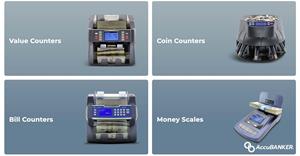
AccuBANKER provides commercial cash-handling systems designed for operational efficiency and reconciliation workflows.
AccuBANKER commercial cash-handling solutions with 40 years of industry experience and price match guarantee

AccuBANKER has more than 40 years of experience providing commercial-grade cash-handling solutions across North America.
Diagram showing counterfeit bill detection methods including ultraviolet features, magnetic ink, infrared features, security threads, and watermark authentication
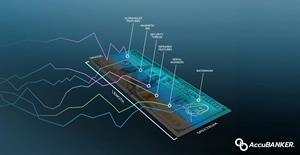
Modern counterfeit detection systems use multiple authentication layers to identify suspicious currency.
Legal Disclaimer:
EIN Presswire provides this news content "as is" without warranty of any kind. We do not accept any responsibility or liability for the accuracy, content, images, videos, licenses, completeness, legality, or reliability of the information contained in this article. If you have any complaints or copyright issues related to this article, kindly contact the author above.
